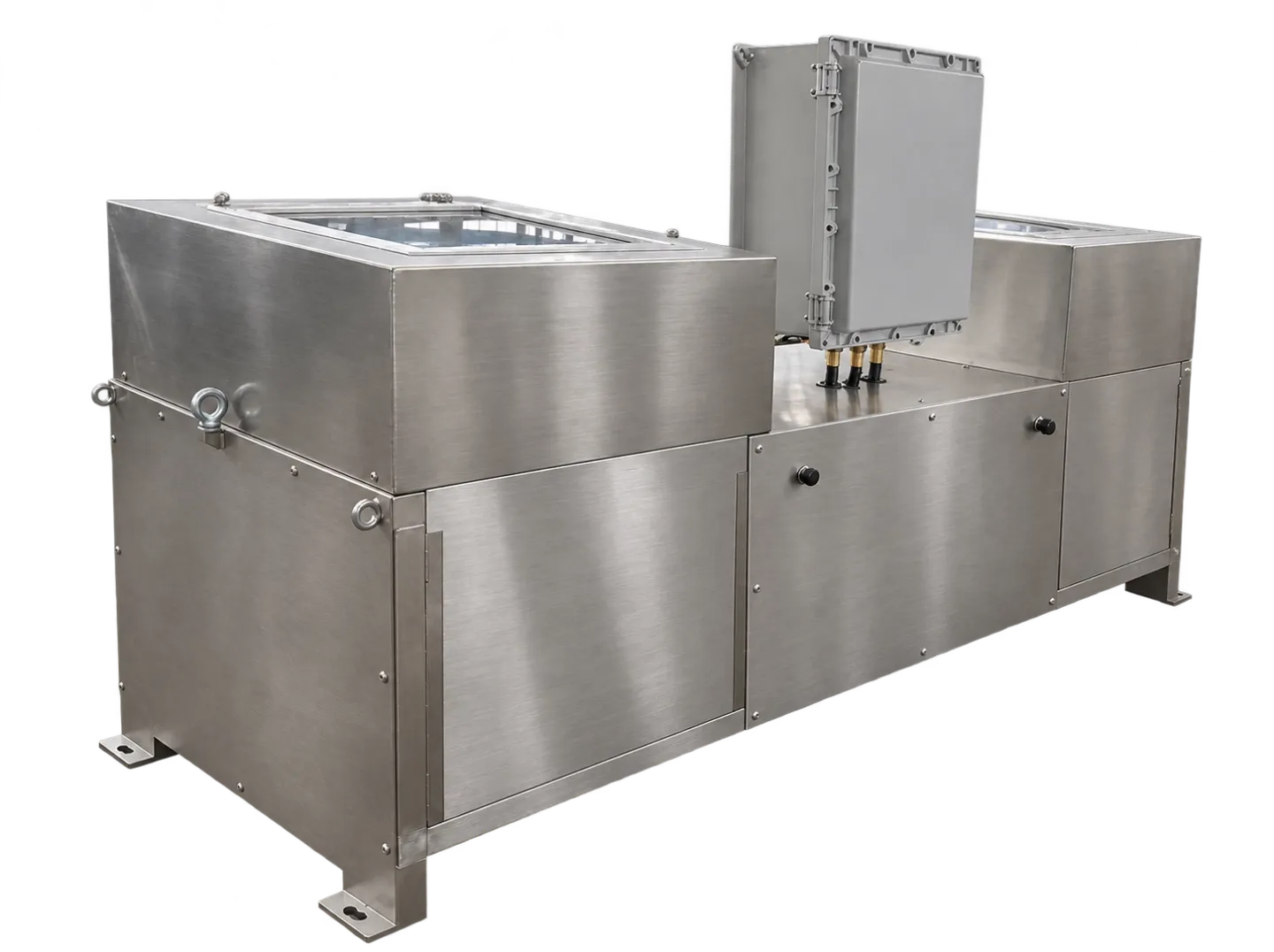
DT-D20C Custom Dual 20L Pneumatic Drum Tumbler
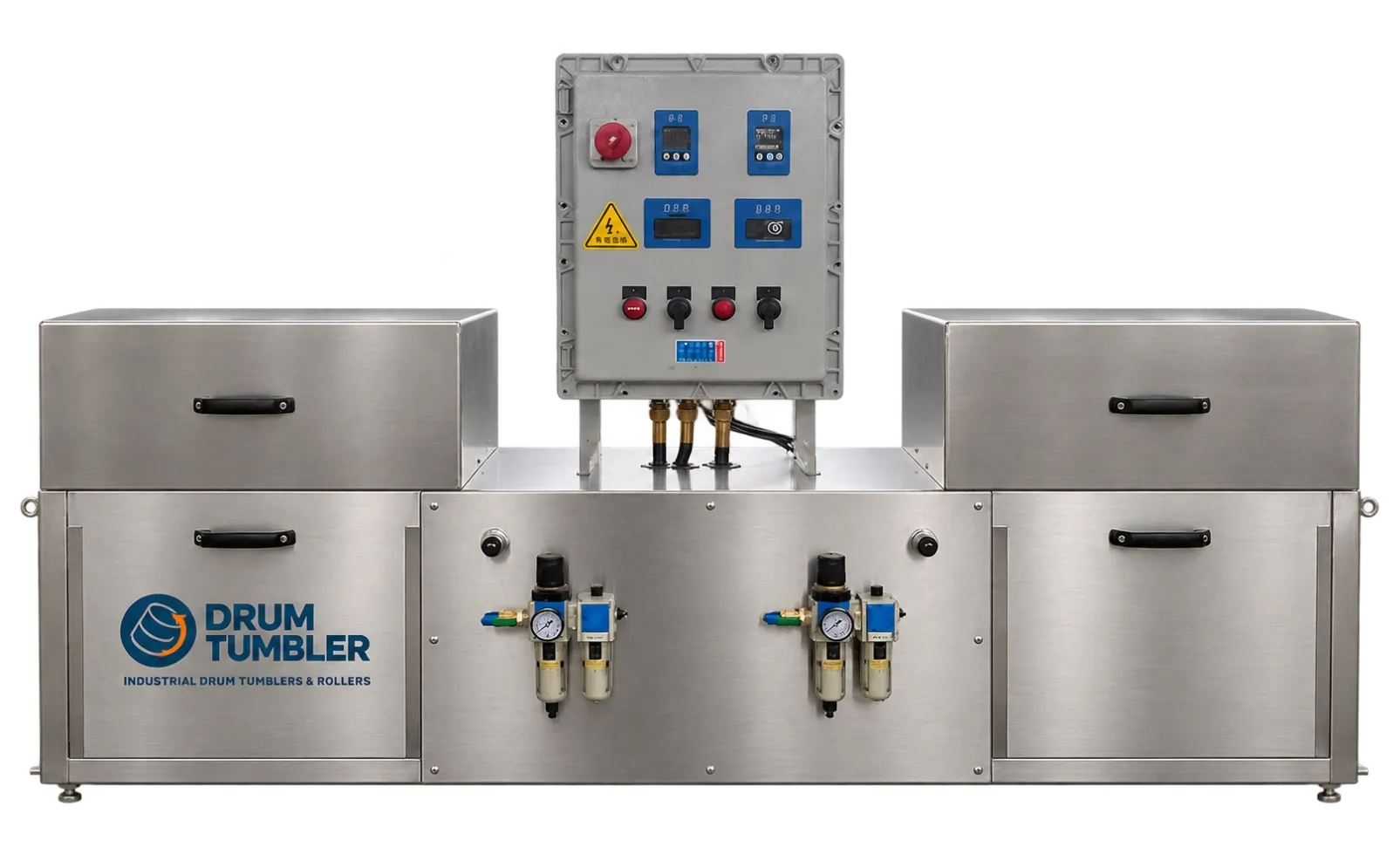
The DT-D20C is a customer-customized dual-station pneumatic drum tumbler that tumbles two sealed 20 L drums in one cycle. It combines an SS304 stainless steel housing, two enclosed mixing compartments with transparent viewing windows, internal drum clamps and a separate customized explosion-protected control box. Working air pressure 0.2-0.6 MPa; mixing time adjustable from 0 to 120 minutes.
Specifications
- Model
- DT-D20C
- Equipment Type
- Enclosed dual-station pneumatic drum tumbler
- Mixing Capacity
- 2 × 20 L drums per cycle
- Drive Method
- Pneumatic motor
- Working Air Pressure
- 0.2–0.6 MPa
- Mixing Motion
- 360° drum tumbling
- Rotation Direction
- Forward / Reverse
- Rotation Speed
- Adjustable
- Mixing Time Setting
- 0–120 minutes
- Housing Material
- SS304 stainless steel
- Drum Holding
- Internal clamping fixture for each drum
- Enclosure
- Two covered mixing compartments
- Observation
- Transparent viewing window on each upper cover
- Electrical Control
- Separate customized explosion-protected control box; certification and ratings to be specified
- Intended Installation
- Customer project involving a potentially flammable or explosive workshop, subject to hazardous-area assessment
The DT-D20C Custom Dual 20L Pneumatic Drum Tumbler is designed to tumble two sealed 20 L material drums in the same mixing cycle. It combines a compressed-air-driven tumbling mechanism with two enclosed mixing compartments, an SS304 stainless steel housing, transparent viewing windows on the upper covers, and a separate explosion-protected electrical control box specified for the customer's project.
The customer requested this configuration for a workshop where flammable or explosive atmospheres may be present. The pneumatic drive avoids using an electric motor as the main tumbling drive, while the enclosed drum holders keep the rotating containers separated from normal operator access. The viewing windows allow operators to observe drum movement without opening the covers.
Important safety clarification: A pneumatic drive and an explosion-protected control box do not, by themselves, certify the entire tumbler for every hazardous location.
Highlights
- 2 × 20 L: two material drums processed simultaneously in separate enclosed stations
- Pneumatic drive: compressed-air-powered rotation with forward/reverse operation
- 360° tumbling: rotates securely held drums to redistribute compatible contents
- SS304 construction: stainless steel machine housing for corrosion-resistant service
- Dual transparent viewing windows: one on each upper lid for observing drum motion
- Customized explosion-protected control box: operator controls and timing functions as specified for this project
- Internal drum clamps: secure each container during rotation
- Adjustable mixing time: 0–120 minutes listed in the product catalog
Why This Custom Dual-Drum Design?
Two 20L Drums in One Cycle
The DT-D20C provides two independent drum positions within a common machine. Each drum is restrained in its own holder before the covers are closed. Both drums can then be tumbled in the same operating cycle, subject to the approved drum and load configuration. The layout is useful where small industrial batches are supplied in sealed containers and operators want to minimize repeated manual mixing steps.
Pneumatic Drive for a Hazardous-Area-Oriented Configuration
The machine uses a pneumatic motor rather than an electric motor for its primary drum rotation. The supplied catalog specifies a working compressed-air pressure of 0.2–0.6 MPa. Air-driven equipment may be considered when electrical ignition sources must be controlled, but mechanical friction, static electricity, heated surfaces, air exhaust, connected electrical devices, and the materials being mixed still require a complete risk assessment.
SS304 Enclosure and Closed-Drum Operation
The housing is specified as 304 stainless steel. Each mixing compartment has a closed upper lid. Processing materials in their original, properly sealed drums can reduce the need for transfer into a shared vessel, helping limit potential spills, cross-contamination, and cleaning between compatible batches.
Two Viewing Windows
A transparent observation window on each lid lets operators check the rotating drum's movement while the covers remain closed. The windows are intended for visual observation of the machine's internal motion; they do not establish product homogeneity by themselves.
Adjustable Drum Holding Fixtures
Internal drum clamps hold the containers against movement relative to the rotating holders. The holder geometry should be checked against each customer's drum diameter, height, closure type, and filled weight. Do not assume every 20 L pail has identical dimensions.
Custom Explosion-Protected Control Arrangement
The pictured machine has a separate electrical control box requested for a potentially flammable workshop. The catalog describes control functions for operation, stopping, direction selection, and timing.
Technical Specifications
| Parameter | DT-D20C Custom Configuration |
|---|---|
| Model | DT-D20C |
| Equipment Type | Enclosed dual-station pneumatic drum tumbler |
| Mixing Capacity | 2 × 20 L drums per cycle |
| Drive Method | Pneumatic motor |
| Working Air Pressure | 0.2–0.6 MPa |
| Mixing Motion | 360° drum tumbling |
| Rotation Direction | Forward / Reverse |
| Rotation Speed | Adjustable |
| Mixing Time Setting | 0–120 minutes |
| Housing Material | SS304 stainless steel |
| Drum Holding | Internal clamping fixture for each drum |
| Enclosure | Two covered mixing compartments |
| Observation | Transparent viewing window on each upper cover |
| Electrical Control | Separate customized explosion-protected control box; certification and ratings to be specified |
| Intended Installation | Customer project involving a potentially flammable or explosive workshop, subject to hazardous-area assessment |
Product Structure
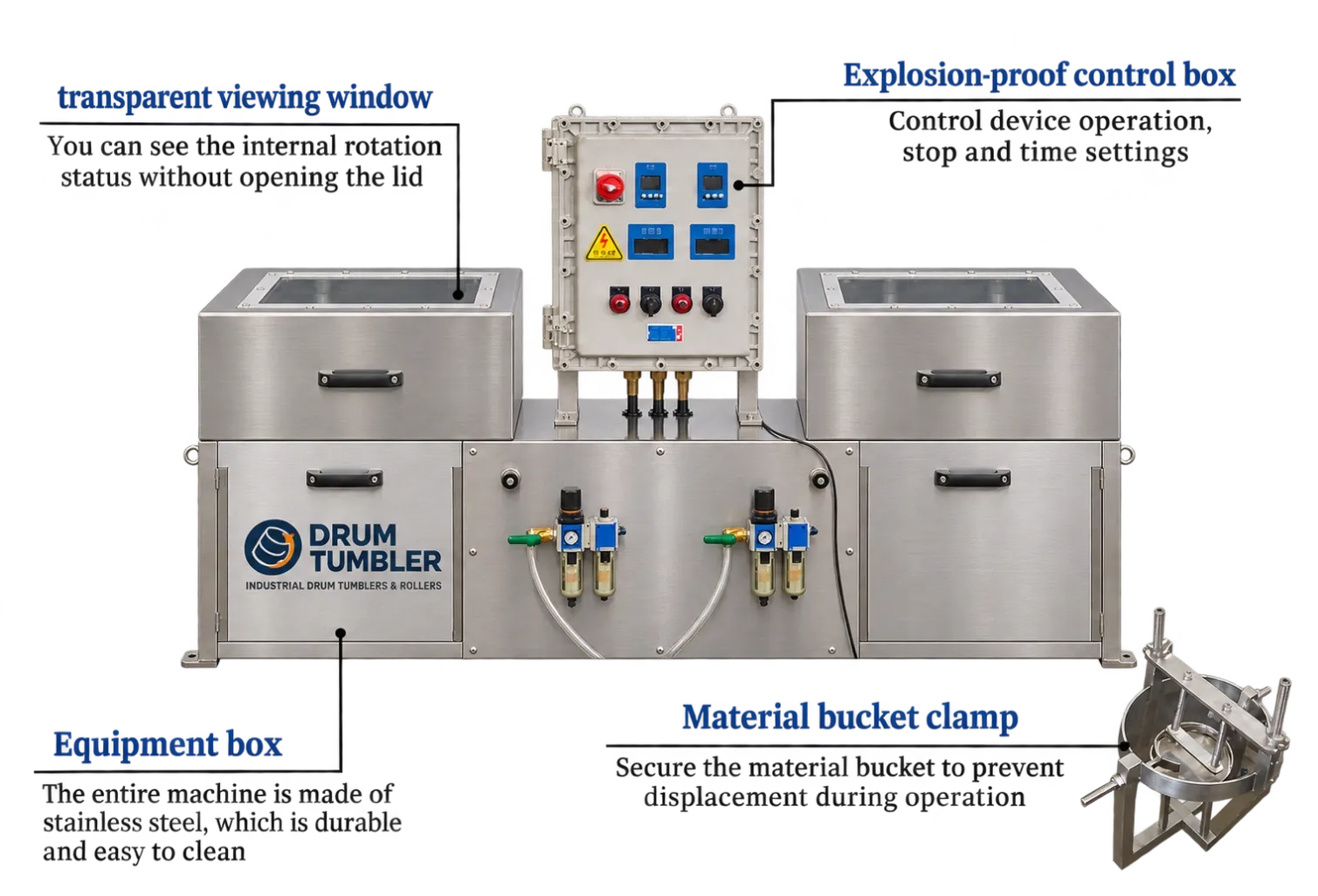
Technical illustration of the DT-D20C dual enclosed drum tumbler: two covered mixing compartments with internal drum holders, and the customized control box mounted between them.
How the DT-D20C Works
- Check the containers. Confirm that each 20 L drum is compatible with tumbling, properly closed, and within the approved size and filled-weight limits.
- Load the two holders. Open the upper covers and place each drum in its designated internal clamping fixture.
- Secure the drums. Tighten and check the drum restraints before operating the rotating mechanism.
- Close the lids. Close both protective covers and follow the site's operating and guarding procedure.
- Set the process. Connect the specified compressed-air supply; use the approved control arrangement to select direction, speed where configured, and mixing time.
- Tumble the sealed containers. The pneumatic drive rotates the restrained drums through their tumbling motion to redistribute compatible contents.
- Stop and unload safely. Wait until all moving parts have stopped and follow the approved isolation/access procedure before opening a cover and releasing the drums.
The required mixing cycle depends on formulation, viscosity, fill level, degree of settling, and the uniformity target. A timer setting is not a guarantee of mixing performance.
Typical Applications
Paints and Coatings
Tumbling can help redistribute settled ingredients in suitable paint and coating formulations shipped in sealed 20 L containers. The formulation must be evaluated if it forms hard sediment or has a high yield stress.
Printing Inks and Colorants
Compatible fluid inks and colorant concentrates may benefit from container tumbling before dispensing or subsequent processing. Dispersion quality and any remaining agglomerates should be checked by the applicable quality-control procedure.
Solvent-Based Chemical Formulations
The project configuration was requested for a workshop involving flammable or explosive atmospheres. The machine may be evaluated for suitable solvent-based products only after confirming site classification, ignition-risk controls, container integrity, materials compatibility, and equipment conformity.
Resins, Adhesives, and Industrial Liquids
Tumbling may help re-homogenize compatible drum-packaged liquid materials. Viscosity, temperature sensitivity, fill ratio, and any curing or reaction risks must be assessed before selecting the method.
Application boundary: The DT-D20C is a tumbler, not a bead mill or high-shear disperser. It should not be presented as guaranteed to break hard agglomerates or fully disperse high-viscosity products without testing.
Pneumatic vs. Electric Drum Tumblers
| Consideration | DT-D20C Pneumatic Configuration | Typical Electric Drum Tumbler |
|---|---|---|
| Primary tumbling drive | Compressed-air motor | Electric motor |
| Air supply | Required | Usually not required for the drive |
| Electrical control equipment | Separate customized control box | Normally present |
| Hazardous-area suitability | Requires assessment of complete assembly | Requires assessment of complete assembly |
| Mixing method | Closed-drum tumbling | Closed-drum tumbling |
| Process control | Project-specific pneumatic | Project-specific motor and control arrangement |
A pneumatic motor is not equivalent to an ATEX, IECEx, UL, CSA, or other approval of the complete machine. Any stated hazardous-location certification must be supported by documentation for the actual ordered configuration.
Drum Compatibility and Customization
DT-D20C is a customer-specific dual-20L design. For a configuration review, provide the exact outer diameter and height of the containers, drum material and closure type, total loaded weight of each drum, material characteristics, desired mixing cycle, and hazardous-location requirements. Clamping fixtures, control functions, speed range, and other details must be validated against the actual application.
Safety, Hazardous-Area Review, and Installation
Before commissioning, the customer and supplier should confirm the area classification and all relevant gas/vapor properties; ignition hazard assessment for the full machine, including non-electrical parts; electrical box marking and certificates; earthing/bonding and static-control measures; guarding and access interlocks if required; suitable compressed-air supply; safe operating procedures; and any applicable local machinery and electrical regulations.
Do not assume that the machine is universally "explosion-proof," emits "no sparks of any kind," or is automatically suitable for all flammable workshops solely because the drive uses air. The final hazardous-area suitability depends on the complete engineered and documented installation.
Package Way — Export Packing and Shipping Protection
The final packing specification is agreed at order confirmation. For international shipment, the following is the proposed export packing method, rather than a guaranteed standard crate type:
- Secure the machine: fasten the stainless steel base to a reinforced pallet or crate base suitable for transport and lifting.
- Immobilize the internal holders: restrain both rotating drum fixtures and protect the lid mechanisms, observation windows, clamps, and exposed fittings against transit movement.
- Protect the control box: cover the display, switches, cable entries, and pneumatic/electrical connections; use appropriate cushioning and moisture protection.
- Protect stainless surfaces: use non-abrasive wrapping and protective separators to avoid scratching panels during transport.
- Export enclosure: use a suitable plywood crate or other agreed export packaging according to the shipment route, destination, and handling requirements.
- Shipping confirmation: provide packing photos, package count, final dimensions, net/gross weights, and a packing list after the packing arrangement has been approved and completed.
Workshop and Detail Views
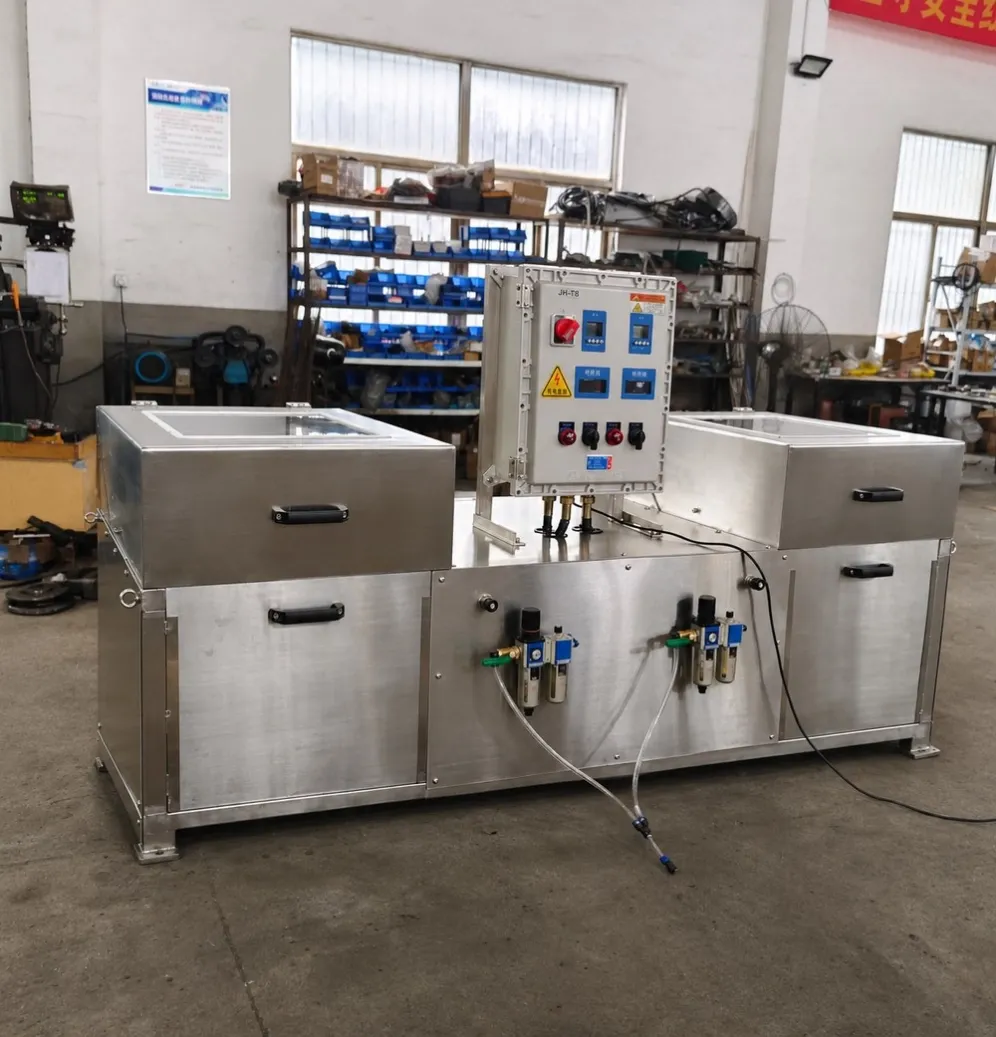
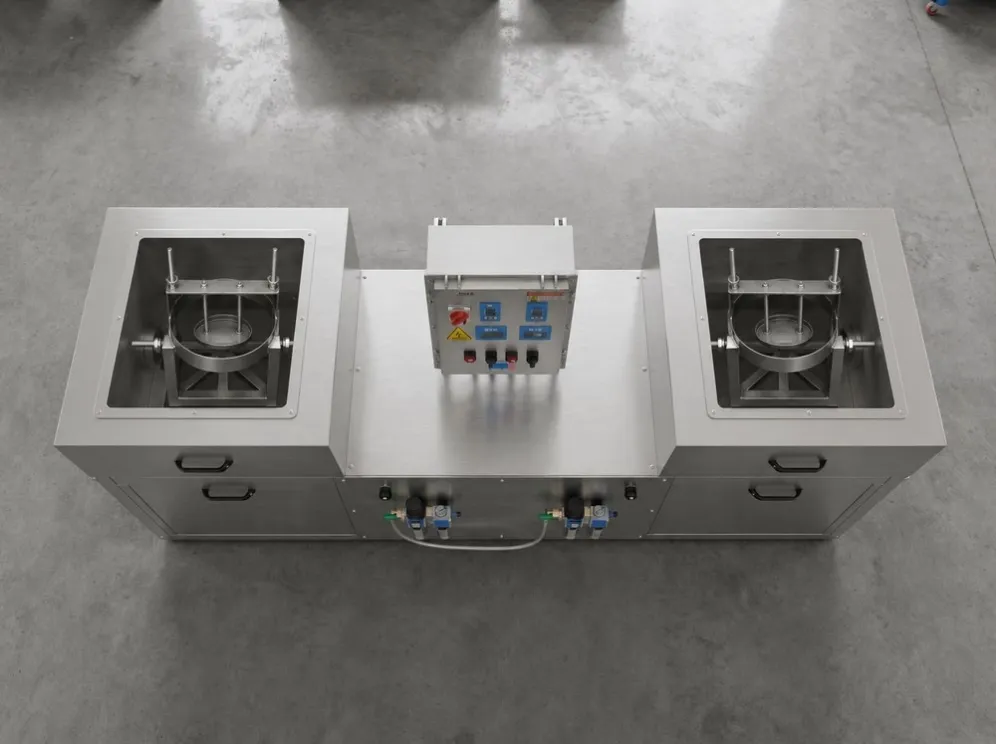
The DT-D20C photographed in the factory (left) shows both enclosed mixing stations with the customized control box mounted between them and the air preparation units on the front panel. The top view (right) shows the two chambers open, with the internal clamping fixture that secures each 20 L drum during rotation.
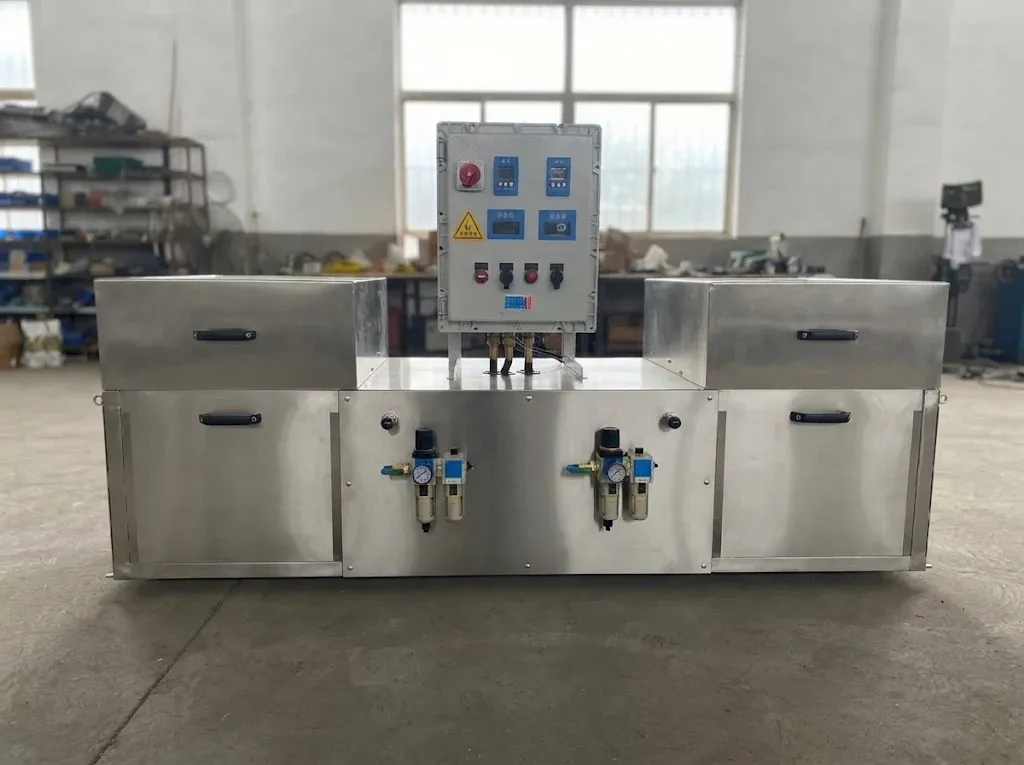
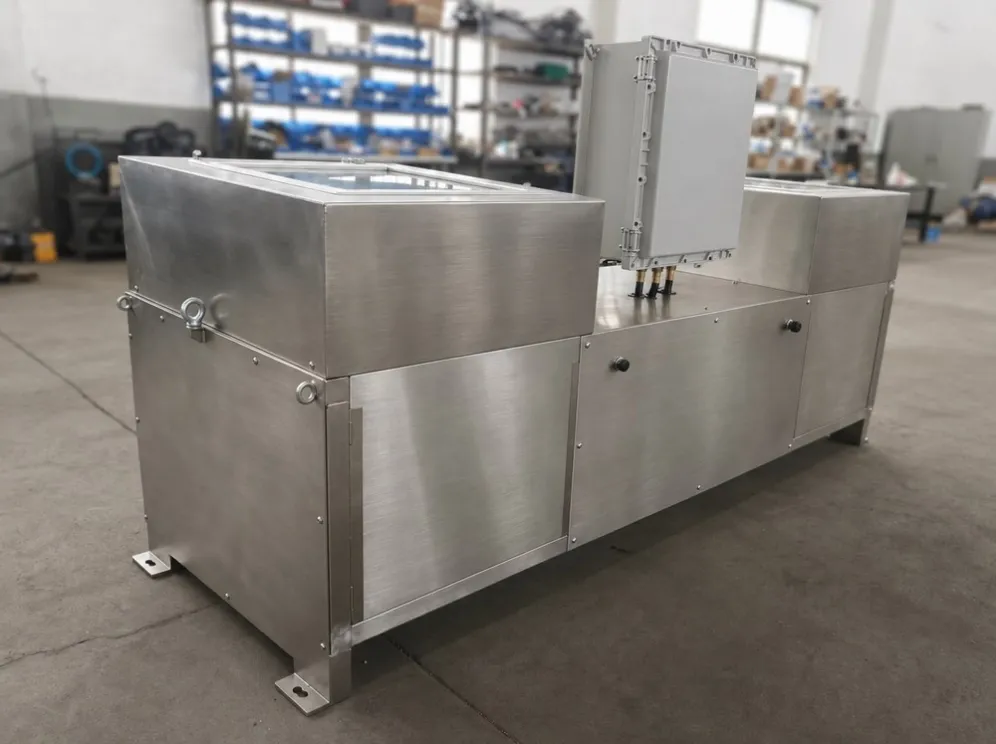
Front view (left): the control box with its switches, displays and timing controls, flanked by the two air filter-regulator units below. Side view (right): the brushed SS304 housing with the transparent viewing window in the upper cover and the control box seen from behind.
Frequently Asked Questions
What is the DT-D20C?
The DT-D20C is a custom dual-station pneumatic drum tumbler that mixes material inside two sealed 20 L drums through external drum rotation.
Can it mix two drums at once?
Yes. The pictured design has two enclosed mixing positions for two 20 L drums in the same cycle, provided the approved loading arrangement is followed.
Does it use an electric motor to rotate the drums?
No. Its primary tumbling drive is pneumatic. The custom machine still has a separate electrical control box, so the electrical equipment and installation must be reviewed for the site.
What compressed-air pressure does it require?
The catalog specifies 0.2–0.6 MPa working air pressure. Air flow/consumption and supply quality should be confirmed for the selected pneumatic drive.
Can the mixing direction be reversed?
The catalog specifies forward and reverse operation. The exact control sequence should be agreed for the final machine configuration.
What is the rotation speed?
The catalog has conflicting numerical speed ranges. The model supports an adjustable configuration.
Does each mixing chamber have a viewing window?
Yes. This customer-specific model has a transparent viewing window in each upper cover to observe drum movement while the enclosure is closed.
Is the machine made of stainless steel?
The catalog specifies SS304 stainless steel for the machine housing. Material certificates and the material of each individual component should be defined in the order documentation if required.
Is DT-D20C certified for explosion-proof workshops?
The machine was customized for a customer operating in a potentially flammable or explosive workshop, and a customized explosion-protected electrical control box is shown. This does not establish certification of the entire machine.
Can I use other 20 L containers?
Potentially, provided the holder and restraint system are compatible. Share the container's dimensions, material, closure arrangement, and loaded weight for confirmation.
Can it mix highly viscous materials or compacted sediment?
Suitability depends on the formulation, flow behavior, fill level, and settling characteristics. Trial mixing or engineering review may be needed; tumbling is not a substitute for high-shear dispersion.
Is the mixing timer included?
The catalog specifies a 0–120 minute setting for the pictured custom equipment. Confirm the exact control functions and stopping logic in the approved quotation.
How is the DT-D20C packaged for export?
An agreed reinforced base and protective export crate may be used, with extra protection for the viewing windows, control box, internal holders, and stainless steel panels. Final packing details are confirmed before shipment.
What information should I send for a quotation?
Provide drum dimensions and filled weight, material name and relevant safety information, viscosity/flow behavior, target mixing time, site hazardous-area classification, compressed-air availability, required control functions, voltage for the electrical control equipment, and destination.
Request a Quote
Need a dual 20 L pneumatic drum tumbler for a classified workshop or a customized industrial mixing process? Share your drum dimensions, liquid properties, compressed-air conditions, hazardous-area requirements, and requested control functions. We can review an appropriate DT-D20C configuration and supporting documentation scope.
CTA: Send Your Drum and Site Specifications