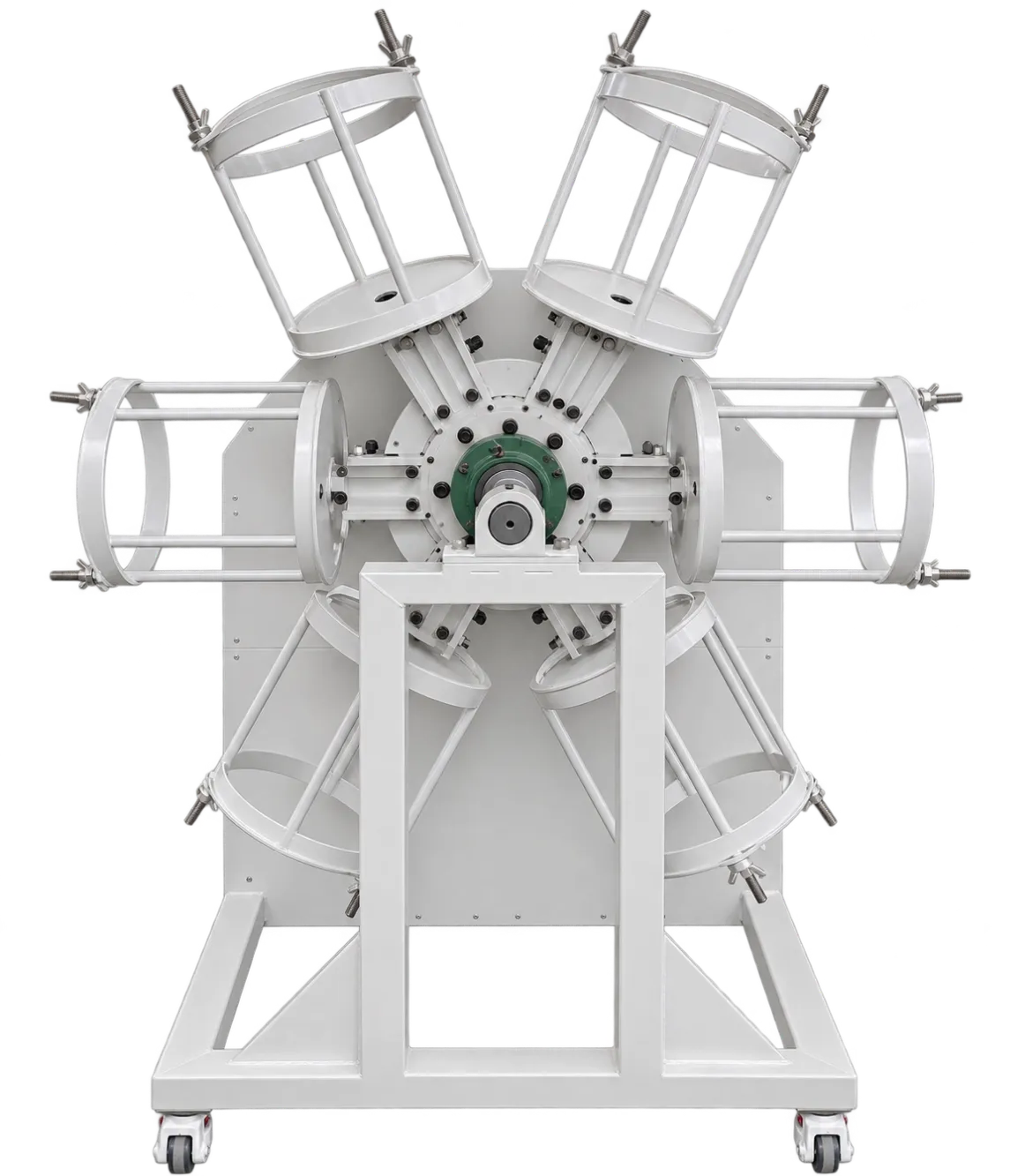
DT-D7C Custom 6+1 Multi-Station Drum Tumbler
The DT-D7C combines six 20L drum stations and one 200L drum station in a single custom machine for closed-drum mixing. The 20L stations use compound revolution and rotation; the 200L station uses 360-degree vertical tumbling. Brochure configuration: 2.2 kW motor, 0-18 rpm customizable speed and a 0-999 minute timer, with an optional interlocked safety fence whose gate triggers a protective stop.
Specifications
- Model
- DT-D7C
- Equipment Type
- Custom 6+1 Multi-Station Drum Tumbler
- Small-Drum Stations
- 6 × 20 L
- Large-Drum Station
- 1 × 200 L
- Total Nominal Container Volume
- 320 L across seven stations (not usable batch capacity)
- 20L Station Mixing Motion
- Compound revolution and rotation
- 200L Station Mixing Motion
- 360° vertical tumbling
- Motor Power
- 2.2 kW (brochure configuration)
- Rotation Speed
- 0–18 rpm, customizable
- Timer Setting
- 0–999 minutes
- Rotation Direction
- One-way / two-way configuration options
- Drive
- Electric motor; explosion-protected motor option
- Main Body Material
- Carbon steel or stainless steel, according to configuration
- Drum Holders
- Dedicated 20L and 200L holding fixtures; fit subject to approval
- Equipment Structure
- 6+1 design
- Mobility
- Swivel casters shown in brochure; installation method subject to configuration
- Safety Guard
- Optional external safety fence
- Safety Gate Interlock
- Optional; opening the gate triggers a protective stop
Product Overview
The DT-D7C Custom 6+1 Multi-Station Drum Tumbler combines six small-drum holders for 20L containers with a separate station for a 200L drum on one industrial mixing machine. It is developed for facilities that work with more than one drum size and need to mix compatible materials without transferring them into a shared mixing vessel.
The two station groups use different movements. According to the product brochure, the 20L stations use compound revolution and rotation, while the 200L station uses vertical 360° tumbling. The brochure describes the 6+1 arrangement as capable of operating the six small-drum positions and large-drum position together.
For compatible paints, coatings, industrial inks, and other drum-stored formulations, the tumbling motion may help redistribute material that has separated or settled during storage. Mixing performance depends on product viscosity, container fill level, sediment characteristics, speed, and cycle duration.
Request a Technical Proposal: Share your drum dimensions, filled weights, materials, and required mixing sequence so that we can evaluate a suitable DT-D7C configuration.
Key Features and Engineering Benefits
1. 6+1 Multi-Station Drum Arrangement
Six 20L drum positions and one 200L drum position are integrated into a single machine. This arrangement addresses manufacturing sites that routinely handle both small-pack and large-drum materials. The nominal combined container volume is 320 L, not a verified usable mixing volume or hourly throughput rating.
2. Compound Revolution and Rotation for 20L Drums
The small-drum group combines a revolving movement around a common mechanism with rotation of the drum holders. This compound motion repeatedly changes container orientation and material movement, helping redistribute compatible contents. It is not an internal impeller or agitator system.
3. 360° Vertical Tumbling for the 200L Drum
The large-drum position uses a 360° vertical turnover movement. The closed container rotates to move material through repeated changes of orientation. This differs from a horizontal drum roller that turns a drum around its lengthwise axis.
4. Closed-Container Mixing
Where the material and container closure are suitable for tumbling, products can remain inside their original drums. This reduces material-transfer and shared-vessel cleaning steps and can limit opportunities for contamination, spills, and operator exposure.
5. Configurable Speed and Cycle Time
The product brochure lists 0–18 rpm (customizable) and a 0–999 minute programmable mixing timer. The final adjustment method, supported operating range under load, and whether both station groups can be controlled independently are subject to the approved machine specification.
6. Custom Drum Holding Fixtures
The 20L and 200L holders are designed around their respective container formats. Actual drum diameter, height, closure type, geometry, and total filled weight must be checked before the holding arrangement is approved.
7. Optional Interlocked Safety Fence
An external safety fence can be specified with an interlocked access gate. When the gate opens during operation, the interlock triggers a protective stop. Safe stopping time, restart prevention, any guard locking, and the required safety-control performance must be determined by the machine risk assessment. The fence is an option, not an assumed standard feature.
8. Custom Drive and Construction Options
The brochure lists carbon-steel or stainless-steel body construction, electric-motor and explosion-protected motor configurations, and movable casters. Electrical equipment selection, hazardous-area suitability, and the final guarding arrangement must match the destination site's requirements.
DT-D7C Technical Specifications
| Parameter | Specification |
|---|---|
| Model | DT-D7C |
| Equipment Type | Custom 6+1 Multi-Station Drum Tumbler |
| Small-Drum Stations | 6 × 20 L |
| Large-Drum Station | 1 × 200 L |
| Total Nominal Container Volume | 320 L across seven stations (not usable batch capacity) |
| 20L Station Mixing Motion | Compound revolution and rotation |
| 200L Station Mixing Motion | 360° vertical tumbling |
| Motor Power | 2.2 kW (brochure configuration) |
| Rotation Speed | 0–18 rpm, customizable |
| Timer Setting | 0–999 minutes |
| Rotation Direction | One-way / two-way configuration options |
| Drive | Electric motor; explosion-protected motor option |
| Main Body Material | Carbon steel or stainless steel, according to configuration |
| Drum Holders | Dedicated 20L and 200L holding fixtures; fit subject to approval |
| Equipment Structure | 6+1 design |
| Mobility | Swivel casters shown in brochure; installation method subject to configuration |
| Safety Guard | Optional external safety fence |
| Safety Gate Interlock | Optional; opening the gate triggers a protective stop |
Technical data are based on the supplied brochure.
Product Structure
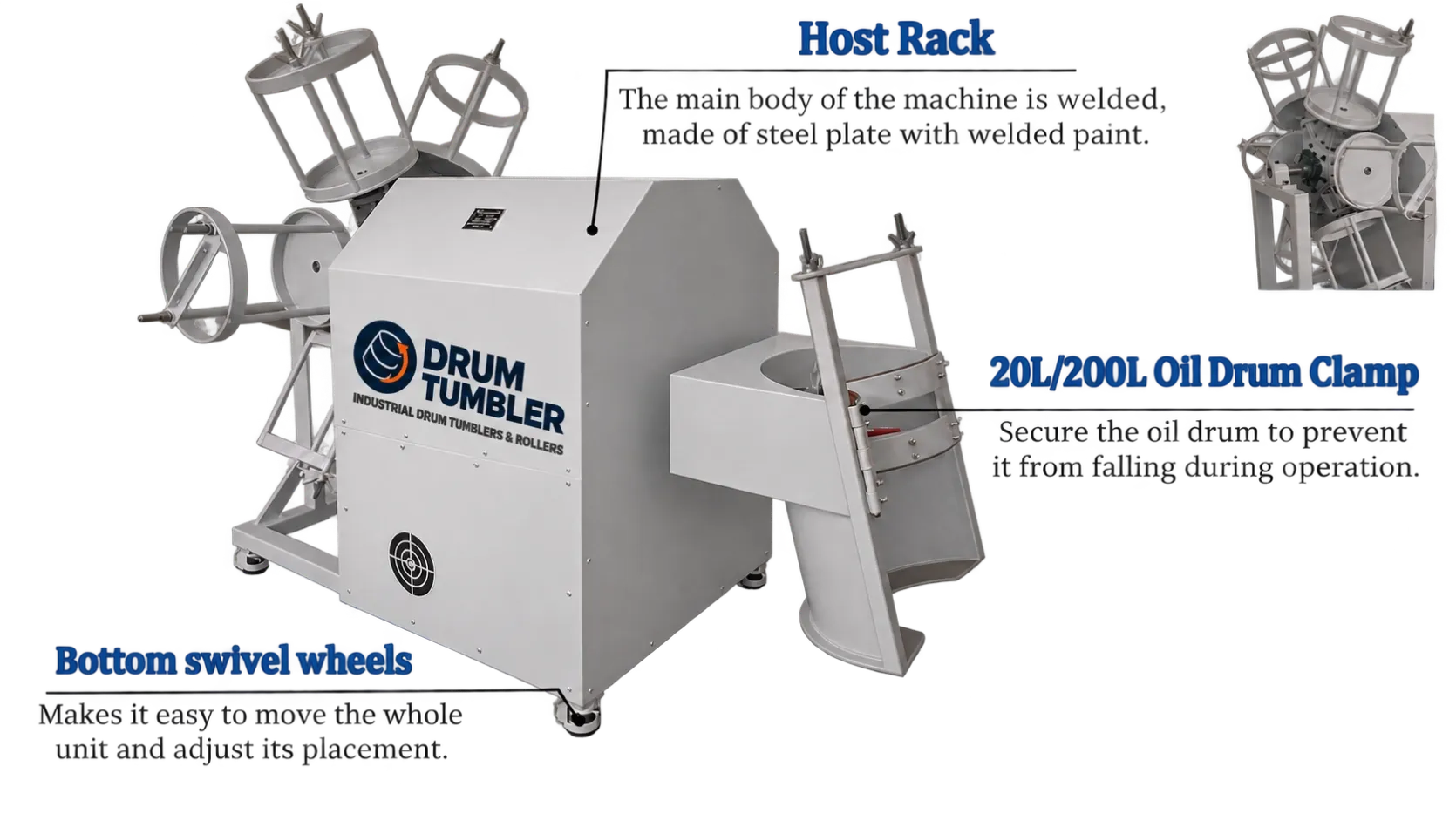
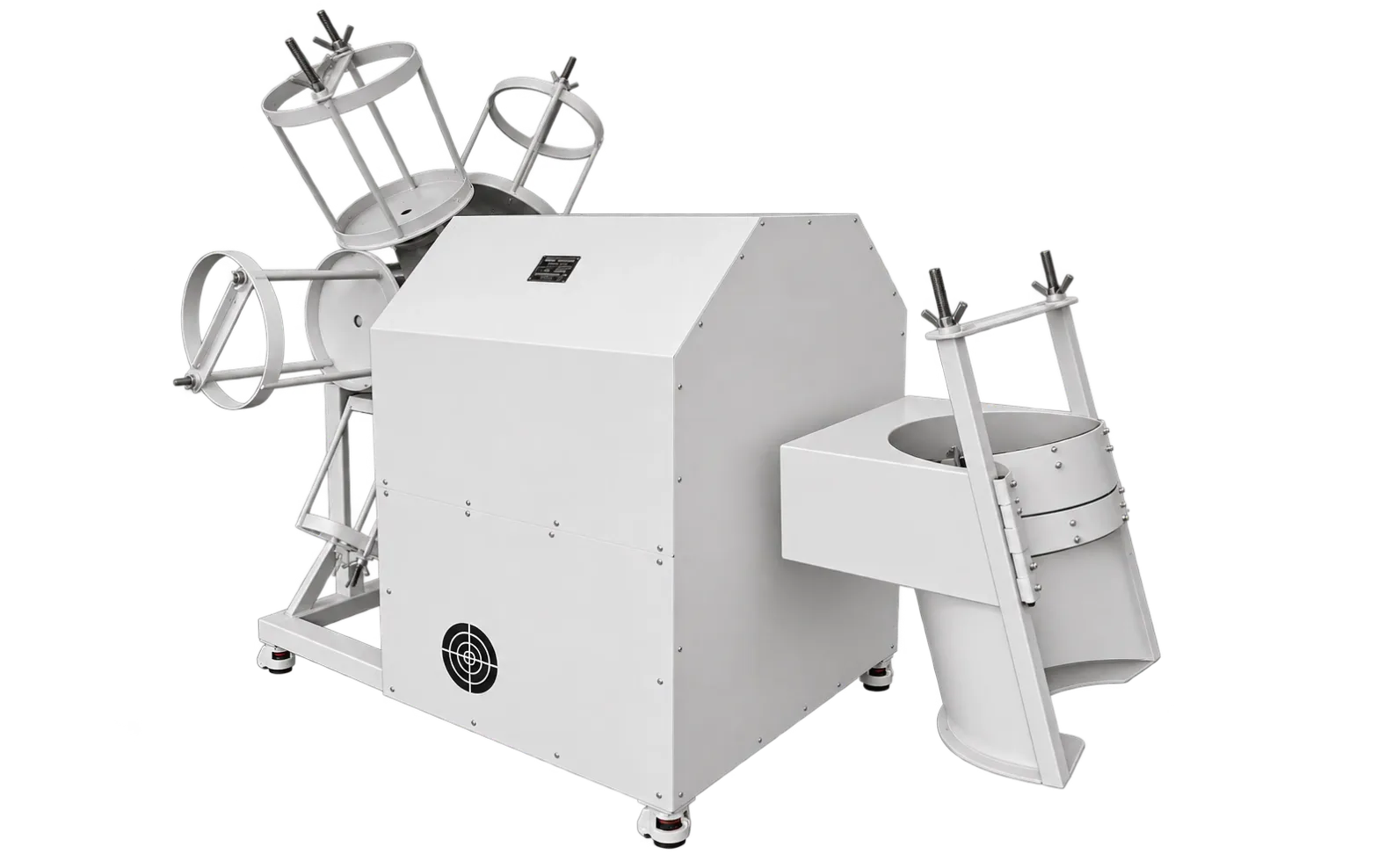
Product structure of the DT-D7C 6+1 multi-station industrial drum tumbler, showing the six 20L drum holders and the 200L drum station.
How the DT-D7C Works
- Confirm material and container suitability. Verify that the materials are appropriate for tumbling, and that containers, closures, and seals can withstand the intended movement.
- Load the drums. Place the 20L drums into their designated holders and the 200L drum into the large-drum station using suitable handling equipment.
- Secure every container. Check the holding fixtures, locks, and retention components before operation.
- Set the mixing cycle. Select the approved rotation speed, direction (where fitted), and timer setting for the material and configuration.
- Close the optional interlocked enclosure. If installed, close and secure the access gate before starting the machine.
- Run the tumbling cycle. The small-drum positions use compound revolution and rotation; the large-drum position uses vertical tumbling, subject to the approved operating arrangement.
- Stop, verify zero motion, and unload. Follow the operating and lockout procedures before accessing rotating parts or removing containers.
Important: A preset time is not a guarantee of mixture uniformity. Validate the cycle with the customer's actual material and desired quality criteria.
Where a 6+1 Multi-Station Drum Tumbler Can Be Useful
Automotive and Industrial Coating Operations
Production or finishing sites that manage multiple sealed paint containers can evaluate the DT-D7C for pre-use re-homogenization. The combination of small- and large-drum stations is particularly relevant where packaging sizes differ between production and application stages.
Paint and Coating Manufacturing
Compatible drum-stored paints and coatings may require redistribution of ingredients after storage. Closed-drum tumbling offers an alternative to pouring material into a shared mixing vessel, provided the mixture, viscosity, and drum fill level are suitable.
Printing Inks, Varnishes, and Industrial Coatings
The machine can be assessed for suitable formulations that need redistribution before use or dispensing. Heavy settled solids, non-flowing pastes, or very high-viscosity products should be evaluated by a practical trial rather than assumed to mix successfully.
Other Compatible Drum-Stored Industrial Materials
Some resins, additives, and industrial liquids may be candidates after a review of chemical compatibility, closure integrity, material behavior, and the intended mixing result. Do not use the equipment for a reactive or otherwise incompatible mixture without a documented process assessment.
Why Choose One 6+1 Machine Instead of Separate Drum Tumblers?
A facility using both 20L and 200L containers may otherwise need different handling and mixing arrangements. The DT-D7C combines these container sizes in a purpose-designed machine, potentially reducing the need for separate equipment where the actual production workflow and mixing requirements justify it.
This is a configurable engineering solution, not a claim of a guaranteed productivity gain. To quantify time savings, compare loading and unloading time, approved simultaneous operation, actual mixing time, staffing, and material test results against the existing process.
20L Compound Tumbling vs. 200L Vertical Tumbling
| Feature | 20L Station Group | 200L Station |
|---|---|---|
| Container Arrangement | Six smaller drum holders | One large-drum holder |
| Motion Described in Brochure | Revolution + rotation | 360° vertical tumbling |
| Intended Purpose | Redistribute compatible materials in smaller sealed drums | Redistribute compatible materials in one large sealed drum |
| Important Selection Factors | Small-drum size, retention, fill level, and material behavior | Large-drum closure, filled weight, handling method, and material behavior |
Neither configuration should be described as a multi-axis internal agitator, bead mill, or high-shear mixer.
Safety Guarding and Gate Interlock
For projects requiring additional operator separation from moving mechanisms, the DT-D7C can be equipped with an external fixed fence and an interlocked access gate. Opening the gate during operation initiates a protective stop. The guarding layout must also address safe access, residual motion, emergency stopping, and prevention of unexpected restart.
The presence of a guard interlock does not itself establish compliance with CE, ATEX, IECEx, UL, CSA, or another certification system. Compliance and certification requirements should be specified in the purchase inquiry and reviewed against the complete machine, its intended country of use, and its installation environment.
Customization and Engineering Review
The DT-D7C can be quoted for an application-specific configuration. The following requirements should be reviewed before the final design is released:
- Actual 20L and 200L drum dimensions and closure styles
- Filled weight of each drum and the intended loaded-station combinations
- Material name, viscosity, fill level, settling behavior, and desired mixing result
- Required speed range, rotation direction, cycle time, and whether independent control is needed
- Available power supply and applicable site electrical classification
- Safety fencing, access-gate location, guard interlock, and emergency-stop requirements
- Frame material, corrosion resistance, and cleaning requirements
- Drum handling, installation, and export packing constraints
Package Way — Export Packing and Shipping Protection
Proposed packaging; the actual packing specification is confirmed with the order.
1. Secure the Equipment Base
Mount the main machine on a reinforced shipping base or export skid. Restrain the frame to prevent movement during loading, transport, and unloading. If casters are fitted, secure the base so that the machine cannot roll inside its packaging.
2. Restrain All Rotating Assemblies
Immobilize the six small-drum holders and the 200L drum holder for transport. Protect shafts, bearings, retention fixtures, protruding edges, and connection points against impact and vibration.
3. Protect Electrical and Safety Components
Cushion the control equipment, switches, displays, motors, cable entries, interlock sensors, and other vulnerable components. Protect exposed surfaces against moisture, abrasion, and corrosion appropriate to the shipping route.
4. Pack Optional Safety Fencing Separately if Required
Where a safety enclosure is ordered, identify the fence panels, doors, interlock components, and fasteners for reassembly. Provide labeling and installation instructions corresponding to the supplied design.
5. Export Packing, Marking, and Documents
Use an export-suitable case, crate, or other agreed packing method. Mark packages with lifting information, center-of-gravity guidance where required, package count, dimensions, gross weight, and handling instructions. Include the final packing list and applicable assembly and operating documentation.
6. Pre-Shipment Confirmation
Confirm final package dimensions, weights, number of packages, packing photographs, and any components shipped detached before arranging freight. No fixed crate dimensions, package weights, or export packing standard are claimed without an approved packing plan.
Workshop and Detail Views
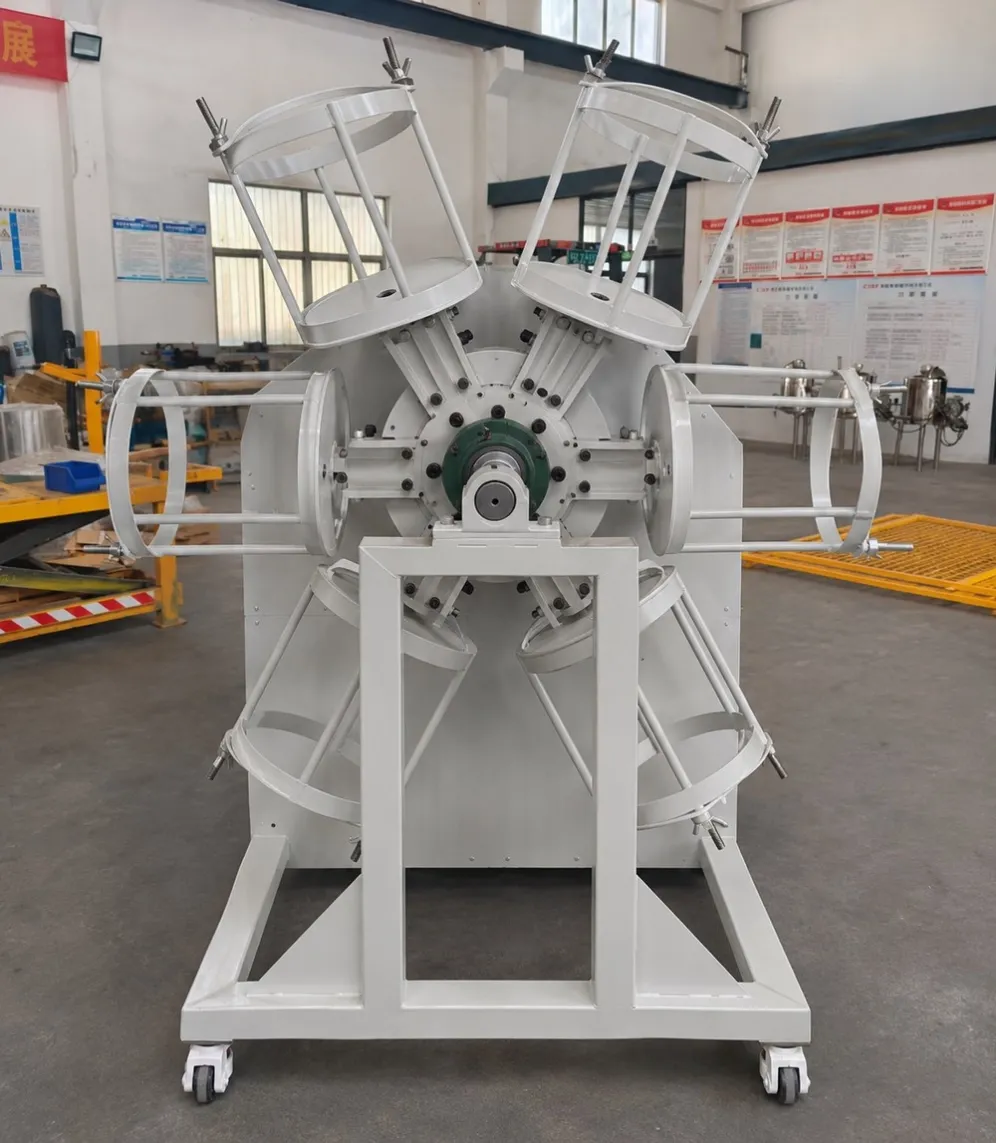
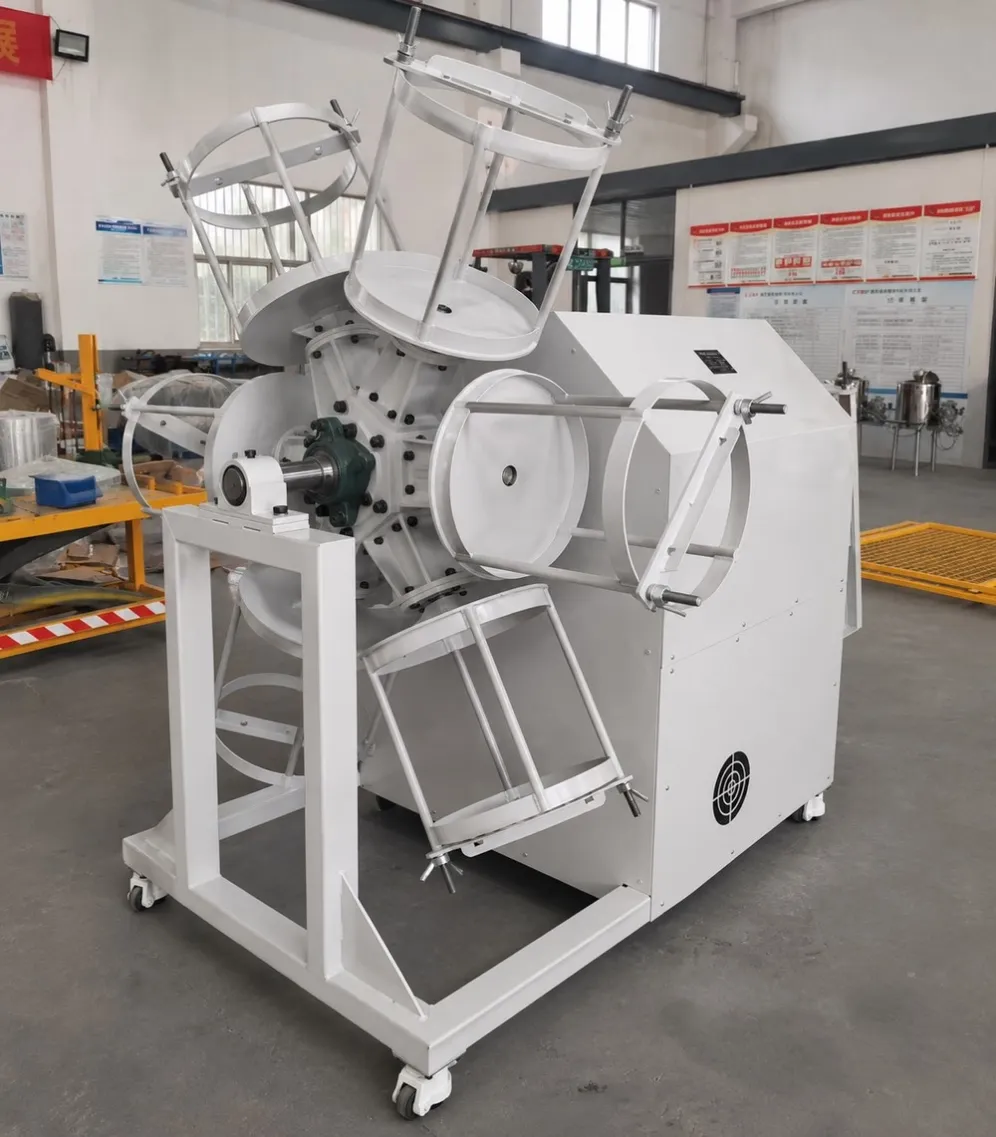
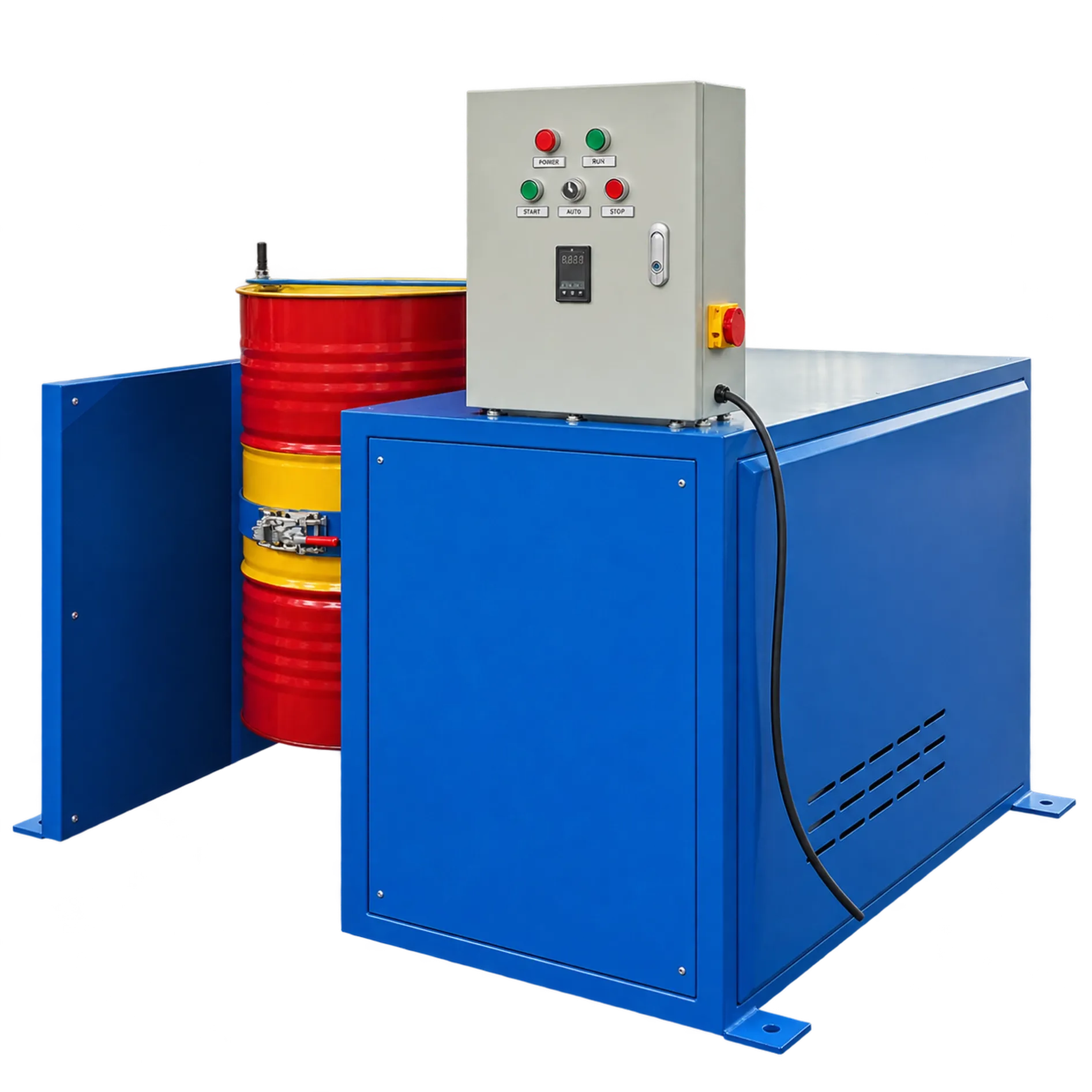
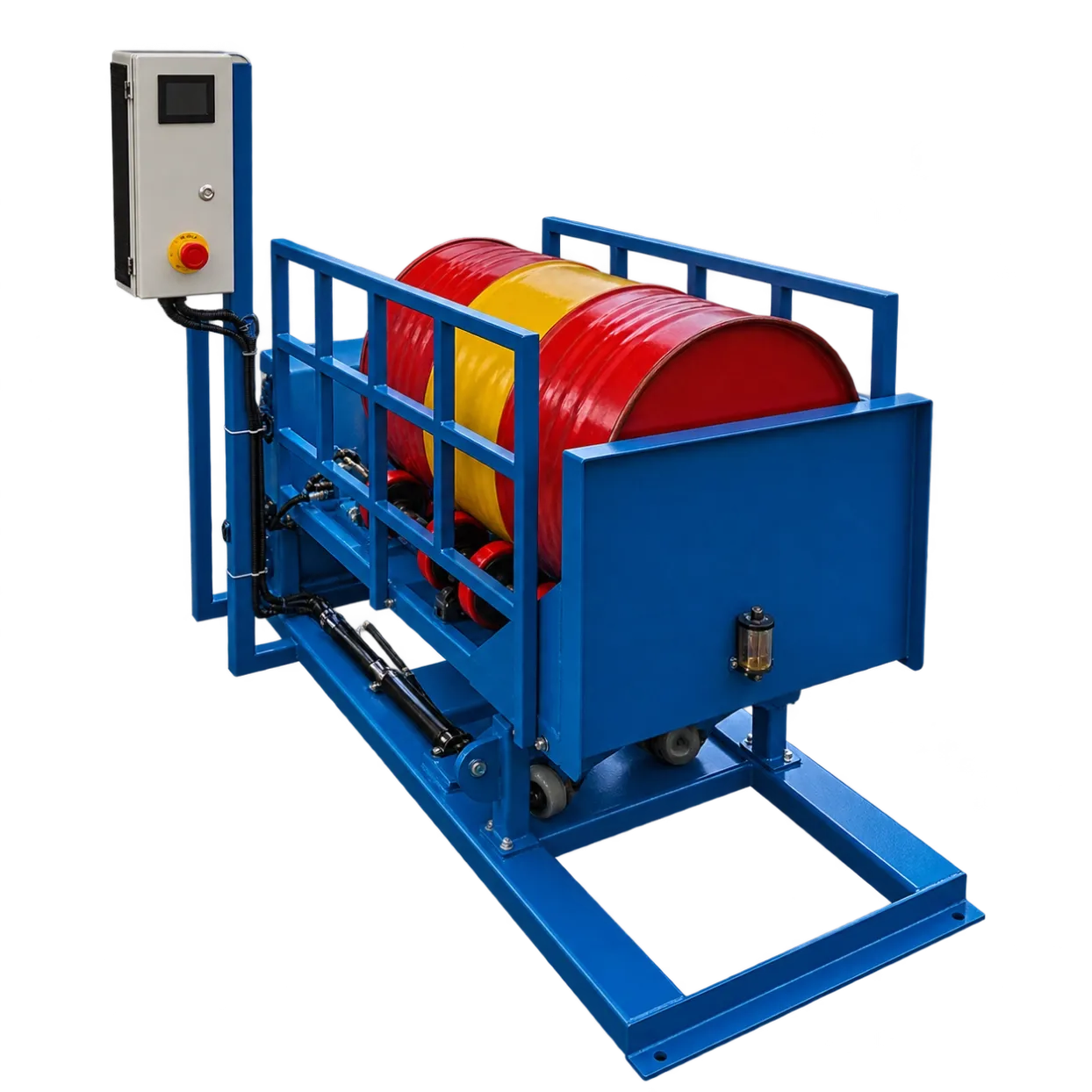
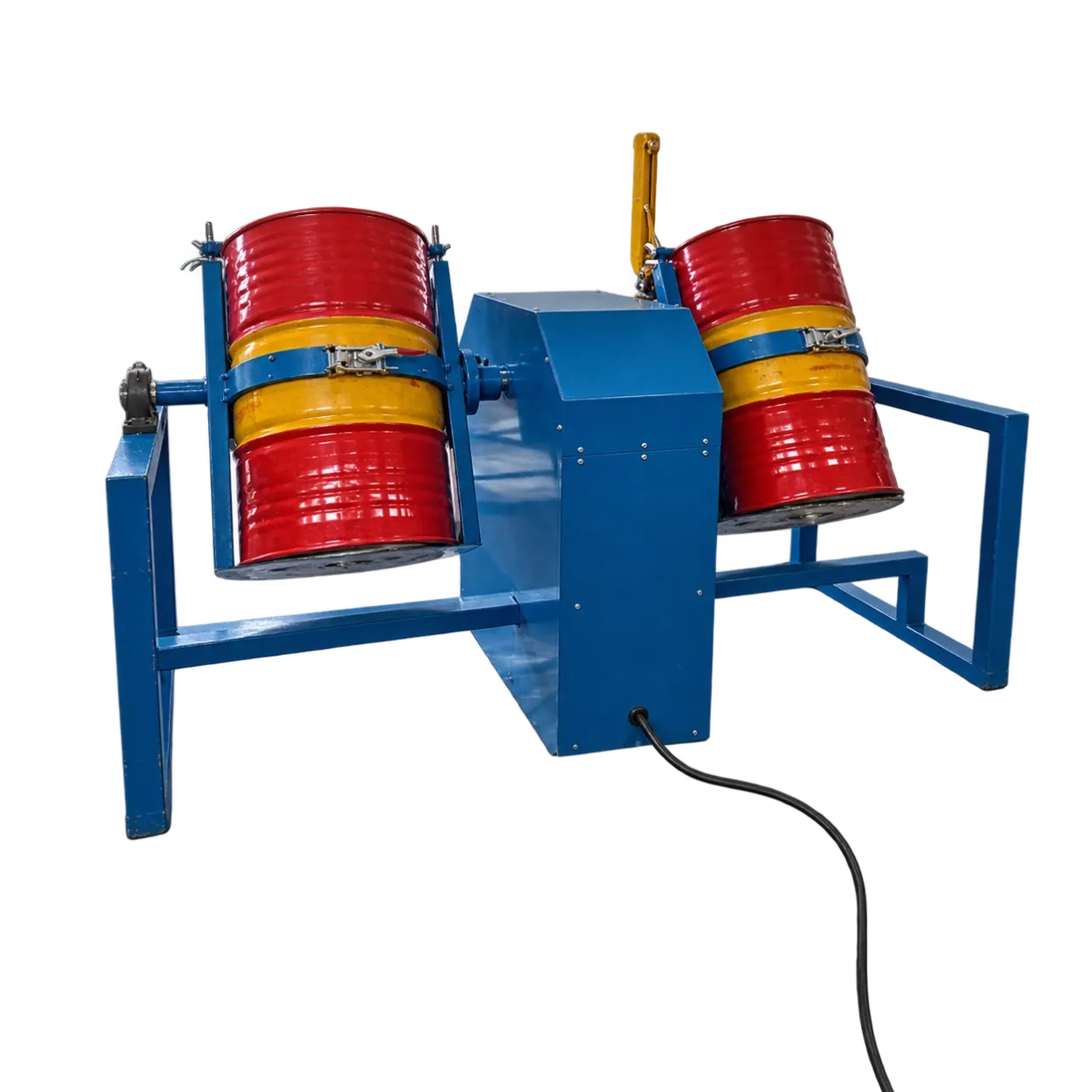
The six 20L drum holders arranged around the central hub of the DT-D7C, and the complete machine with its drive cabinet in the workshop.
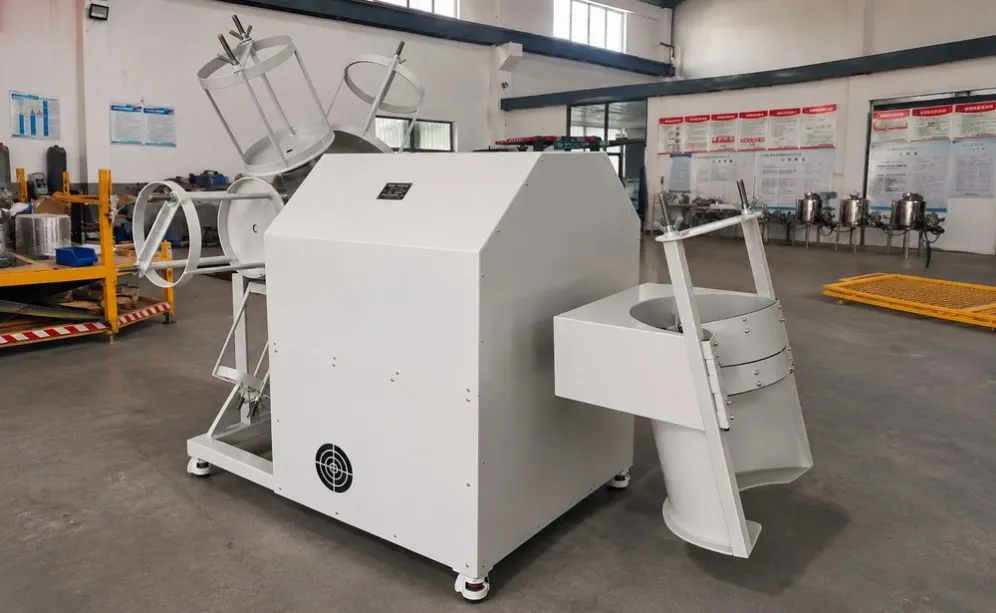
The 200L drum station with its large holding cradle, beside the drive cabinet.
Frequently Asked Questions
What is the DT-D7C?
The DT-D7C is a custom industrial drum tumbler with six 20L drum stations and one 200L drum station. It is intended for mixing compatible material inside closed industrial drums.
Can the DT-D7C handle six 20L drums and one 200L drum in the same machine?
Yes. The brochure specifies a 6+1 arrangement. The brochure also describes simultaneous operation.
Does the machine mix seven independent batches?
It provides seven container positions, but the number of independent batches depends on the material and operating plan. The brochure does not establish seven independent drives or seven independently selectable speed programs.
How does the 20L mixing mechanism differ from the 200L mechanism?
The 20L positions use compound revolution and rotation. The 200L position uses vertical 360° tumbling. Both movements act on the closed container rather than inserting an agitator into the product.
Is the machine suitable for paint and coatings?
It can be evaluated for compatible paint and coating formulations that require redistribution before use. Mixing effectiveness depends on viscosity, settling, fill level, drum geometry, and cycle duration.
What speed can be set?
The supplied brochure lists a customizable speed range of 0–18 rpm. Actual settings and supported loaded operating conditions are defined in the approved configuration.
Is a timer available?
The brochure specifies timer adjustment from 0 to 999 minutes. The selected control design determines how the timer operates and stops the machine.
What happens when the optional safety gate opens?
When the optional interlocked fence is fitted, opening its access gate during operation triggers a protective stop. The specific stopping and restart behavior must be engineered to the assessed risks.
Is the safety fence standard?
No. The external protective fence and access-gate interlock are optional equipment.
Can the machine be supplied for a hazardous area?
The brochure lists an explosion-protected motor option, but does not establish whole-machine hazardous-area certification. Provide the area classification, materials, and applicable standards to request a suitable assessment and configuration.
Can it mix very thick pastes or compacted sediment?
Not necessarily. High-viscosity products or hard-set sediment may not be redistributed sufficiently by tumbling alone. A material trial or process evaluation is recommended.
Does the drum need to be opened for mixing?
For compatible materials and suitably secured containers, the drum remains closed throughout the tumbling cycle.
Can the drum holders be customized?
Yes, the holders can be engineered for the actual container dimensions and closure design, subject to the approved load and safety requirements.
How is the DT-D7C packed for international shipment?
The proposed export method uses a secured base, restraint of rotating assemblies, protective packaging for electrical and safety components, and an agreed export crate or equivalent. Final packing details are confirmed before shipment.
What information is needed for a quotation?
Provide drum specifications, filled weight, material properties, intended mixing procedure, supply voltage, safety requirements, and shipping destination. Indicate whether the optional interlocked fence is required.
Request a Quote for the DT-D7C
Need a mixing system for multiple 20L drums and a 200L drum? Share your container drawings, product information, and mixing objectives. We can review the required station layout, drive configuration, guarding, and shipping arrangement to develop a technical proposal.
CTA: Request a DT-D7C Technical Proposal